

You open a message. Three letters stare back at you: TMB. No context. No emoji. Just TMB.
Sound familiar? You’re definitely not alone. Every day, thousands of people search for the meaning of “TMB” after seeing it pop up in their texts, Instagram DMs, Snapchat messages, or group chats. It’s short, it’s punchy, and depending on who sends it and how it can mean very different things.
This complete 2026 guide breaks down the TMB meaning in text from every angle what it stands for, how it feels depending on tone, what it means when a girl or guy sends it, whether it can be rude, and when you should (or absolutely shouldn’t) use it. By the time you finish reading, you’ll handle TMB in any conversation like a native internet user.
Quick Answer (Featured Snippet Optimized)

TMB stands for “Text Me Back.” It’s a texting abbreviation used when someone wants you to reply to their message. It’s casual, informal, and most commonly used among friends, teens, and young adults on platforms like Snapchat, WhatsApp, Instagram, and iMessage.
| Term | Meaning | Tone |
| TMB | Text Me Back | Casual / Friendly / Neutral |
| TMB | Tweet Me Back | Platform-specific (Twitter/X) |
| TMB | That’s My Bad | Rare, context-dependent |
| TMB | Tell Me Baby | Informal / Playful |
One-line definition: TMB = a casual digital nudge asking someone to reply to your message.
What Does TMB Mean in Text?
TMB means “Text Me Back.” It is a short form used in texting when someone wants another person to reply to their message. Instead of writing a long sentence like “please text me back when you get time,” people simply write TMB.
It started in early SMS culture when people used to save time and characters while typing messages. Now it is commonly used on apps like WhatsApp, Snapchat, and Instagram in casual conversations to remind someone to respond.
Mini Examples:
- “Sent you the details TMB when you’re free!”
- “I have big news. TMB ASAP! 👀”
- “TMB what you think about the plan.”
- “Just saw your message, TMB later tonight.”
These tiny examples already show something important: the same three letters carry different emotional weight depending on what surrounds them.
Where Is TMB Commonly Used?
TMB shows up across practically every major messaging platform. Here’s a breakdown of where you’re most likely to encounter it:
| Platform | How TMB Is Used |
| iMessage / SMS | Direct reply requests between friends |
| Casual one-on-one and group chat nudges | |
| Snapchat | Quick streak replies, response reminders |
| Instagram DMs | Feedback requests, casual conversation |
| Twitter / X | “Tweet Me Back” — a platform-specific twist |
| Discord | Gaming chats, quick response requests |
| TikTok Comments | Casual replies to creators or friends |
Among teens and Gen Z, TMB is almost second nature. It flows naturally into conversation the same way “lol,” “brb,” or “ngl” does. For older millennials or adults, it may feel more unfamiliar which is exactly why so many people end up searching for its meaning.
It’s also worth noting that TMB is almost never used in professional settings. Workplaces, formal emails, or client communications are no place for this kind of shorthand. Stick to full sentences there.
Tone and Meaning Explained
Here’s something most guides miss: TMB doesn’t always feel the same. The exact same three letters can read as warm and friendly, completely neutral, or surprisingly cold depending entirely on tone, context, and relationship.
😊 Friendly Tone
When TMB appears with emojis, exclamation points, or warm phrasing, it feels light and fun. The person isn’t demanding they’re excited to hear back from you.
Examples:
- “TMB when you land! 🛬✈️”
- “Miss you! TMB soon okay? 💛”
- “That sounds amazing TMB with the details!!”
This is TMB at its most harmless and most common. It’s basically the digital equivalent of “give me a call when you get a sec.”
😐 Neutral Tone
Sometimes TMB is just… practical. No emotional charge. The person needs information or a confirmation and they’re keeping it brief.
Examples:
- “Sent you the schedule. TMB.”
- “TMB what time works for you.”
- “We still meeting up? TMB.”
This reads as matter-of-fact. There’s no warmth or coldness just communication efficiency.
😒 Rude or Cold Tone
Without any softening context no emoji, no preamble, just a flat “TMB” it can come across as demanding or passive-aggressive. Especially if the person has already sent multiple messages and is clearly frustrated.
Examples:
- “TMB.” (standalone, no context)
- “I said TMB like an hour ago.”
- “?? TMB.”
In these cases, TMB carries a sharper edge. It’s less of a nudge and more of an expectation. Context and relationship history matter a lot here.
Examples of TMB in Conversation
Let’s look at how TMB actually plays out in real texting scenarios:
Scenario 1 — Making Plans:
Alex: “Want to come to the game Friday?” Jordan: “Maybe! TMB tomorrow when I check my schedule.”
Scenario 2 — Sharing News:
Maya: “I have the BIGGEST update. TMB when you’re done with class!! 😱” Sam: [seen]
Scenario 3 — Asking for Feedback:
Riley: “Just sent you my resume draft. TMB what you think?” Casey: “On it, give me 20 mins!”
Scenario 4 — Mild Frustration:
Taylor: “Hey, I texted you twice. TMB.” Morgan: “Sorry! Just saw this, calling you now.”
Scenario 5 — Casual Catch-Up:
Jamie: “Haven’t talked in forever. TMB sometime this week 🙂” Drew: “YES. Let’s catch up properly!”
Each scenario shows how tone, timing, and context shape the emotional meaning of TMB even when the letters stay exactly the same.
TMB Meaning From a Girl
When a girl sends TMB, it generally means she genuinely wants to hear back from you. It’s often a friendly, low-pressure way of keeping the conversation alive without coming across as needy or demanding.
In a friendship context, it means she’s interested in your response and values the exchange. In a romantic or flirty context, TMB can be a subtle signal of interest she’s leaving the conversation open and inviting you to continue it on your terms.
Girls tend to pair TMB with emojis or warmer phrasing more often than not, which softens the request and makes it feel like an invitation rather than a command.
Example:
“Just got home from the worst day ever lol. TMB when you’re free? Need to vent 😅”
Translation: She wants to talk. She’s being casual about it, but the invitation is real. Reply when you can she’s not rushing you, but she does want to hear from you.
TMB Meaning From a Guy
When a guy sends TMB, it’s usually direct and functional. Guys tend to use it as a practical shorthand either to confirm plans, get a quick answer, or just acknowledge that they want a response without writing a long message about it.
In a casual friendship, it’s just efficient communication. In a dating or romantic setting, a guy using TMB shows he’s thinking about you and wants to keep the conversation going but in a low-key, unbothered way.
The lack of emojis doesn’t necessarily mean coldness. Many guys simply type short and move on. Read the broader conversation, not just the three letters.
Example:
“Good game today. TMB about the weekend plans.”
Translation: He’s checking in and wants to coordinate. It’s practical, but it’s also engagement he’s initiating.
Is TMB Ever Rude or Offensive?
On its own, TMB is not rude or offensive. It’s a neutral acronym. But tone, frequency, and context can absolutely make it feel uncomfortable.
🚫 Can Feel Rude If:
- Sent alone with zero context after being ignored
- Used repeatedly in a short time frame (“TMB.” then “TMB??” then “???”)
- Sent by someone who already has a tense or cold dynamic with you
- Written in all caps: “TMB NOW”
- Paired with frustration cues: “I said TMB hours ago.”
😐 Can Feel Dry If:
- No emoji, no warmth, just one flat “TMB” at the end of a message
- Sent to someone you don’t know well without context
- Used in a serious conversation where a warmer approach is expected
✅ Can Feel Polite If:
- Paired with a friendly message or emoji
- Used between close friends who understand each other’s communication style
- Said with softening phrases: “No rush! TMB when you can 😊”
Bottom line: TMB is only as rude as the energy around it. Alone, it’s neutral. In context, it reflects the relationship.
When to Use and When NOT to Use
Not every situation calls for TMB. Here’s a quick-reference guide to help you decide:
✅ USE TMB when:
- Texting close friends or people you’re comfortable with
- You want a reply but don’t want to sound demanding
- The conversation is casual and light
- You’re on an informal platform like Snapchat, WhatsApp, or iMessage
- You’re already mid-conversation and just want a response
❌ DO NOT USE TMB when:
- Messaging a boss, coworker, or professional contact
- Writing a formal email or any workplace communication
- Texting someone you’ve just met or don’t know well
- The conversation is serious or emotionally sensitive
- You’re in a cross-cultural exchange where the slang may confuse
| Situation | Use TMB? | Better Alternative |
| Text to best friend | ✅ Yes | — |
| DM to close follower | ✅ Yes | — |
| Email to employer | ❌ No | “Please reply at your convenience.” |
| Message to new acquaintance | ❌ No | “Let me know what you think!” |
| Group chat with mixed ages | ⚠️ Maybe | “Let me know!” |
| Romantic interest | ✅ Yes | — |
TMB Meaning in Chat vs Social Media
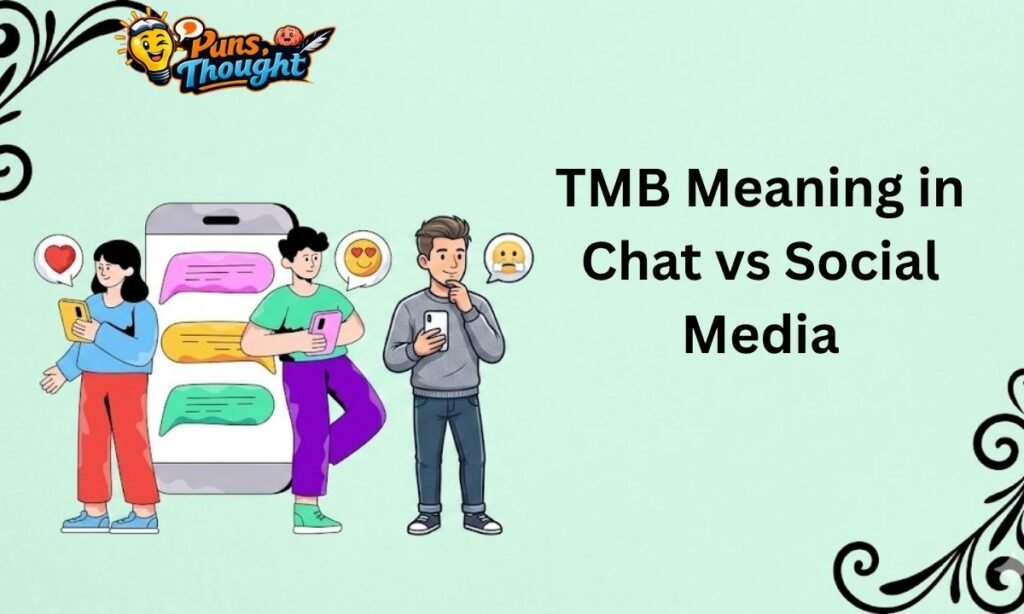
TMB doesn’t behave exactly the same way across every platform. Private chat and public social media carry different social norms, so the same three letters can land differently depending on where they appear.
💬 In Chat (Private Messages):
In one-on-one conversations, TMB is a straightforward request. It’s personal, direct, and means exactly what it says: reply to me. The tone depends entirely on the relationship between the two people texting.
It works well in casual back-and-forth exchanges checking in on plans, asking for opinions, following up on shared information. Private chat TMB is almost always about maintaining conversation flow.
🌐 On Social Media:
On public or semi-public platforms, TMB can shift meaning slightly. On Twitter/X, it sometimes means “Tweet Me Back” a request for someone to reply to your tweet or tag. On Instagram, it might appear in comments as a playful nudge for the account owner to reply to a DM.
In some communities, especially teen or youth-centered groups, TMB in a comment on a photo might be used to mean “That’s My B*tch” a slang expression of loyalty or close friendship (similar to calling someone your ride-or-die). This meaning is hyper-contextual and mostly appears between very close friends.
Always read the platform, the relationship, and the surrounding content before deciding which meaning applies.
Similar Slang Words or Alternatives
If TMB feels too blunt for a particular situation, there are plenty of alternatives that carry a similar meaning with slightly different energy:
| Slang / Phrase | Meaning | Tone Compared to TMB |
| HMU | Hit Me Up | More casual, invitation-style |
| LMK | Let Me Know | Softer, less direct |
| TTYL | Talk To You Later | Conversational sign-off |
| BRB | Be Right Back | About availability, not reply |
| Reply when free | Full phrase | More polite, professional-adjacent |
| Ping me | Informal request for contact | Slightly more tech/work culture |
| Slide into my DMs | Casual contact request | More playful / flirty |
Where TMB sits in this spectrum: TMB is more direct than LMK but softer than ASAP. It’s an expectation wrapped in casual language less demanding than “respond now” and less passive than “whenever you get around to it.”
Other Meanings of TMB
While “Text Me Back” is overwhelmingly the most common meaning, TMB can stand for other things depending on context:
| Meaning | Context |
| Text Me Back | Standard texting and messaging (most common) |
| Tweet Me Back | Twitter/X platform-specific |
| That’s My Bad | Rare, used humorously to admit a mistake |
| Tell Me Baby | Playful, romantic or flirty conversations |
| Text Me Bro | Casual male friendships |
| Too Many Bills | Slang used in financial humor or meme culture |
| The Management Board | Rare corporate/professional context |
| Throwback | Extremely rare; usually “TBT” is used instead |
In the overwhelming majority of everyday conversations, you can safely assume TMB means Text Me Back. The alternative meanings only emerge in very specific contexts and are always shaped by the surrounding conversation.
Why Do People Use TMB?
It might seem like a small thing three letters. But the reasons people reach for TMB instead of typing a full sentence are actually pretty interesting.
📱 Fast Typing
Smartphones are incredible, but they’re not always great for long messages on the go. TMB lets someone communicate a complete thought “please respond to my message” in a fraction of a second. Speed matters in digital communication, especially when you’re juggling multiple conversations at once.
🌍 Internet Culture
Online communication has its own evolving language. Slang like TMB is part of that culture a shared shorthand that signals group belonging. Using it correctly shows that you’re fluent in the informal language of the internet, which carries social value among younger users and close friend groups.
⚡ Convenience
Typing out “Hey, could you please text me back when you get a moment?” is functional but slow. TMB compresses that entire request into three keystrokes. In a culture of constant pinging and rapid response expectations, efficiency wins every time.
🧠 Habit
For many people, especially teens and young adults who grew up texting, TMB is simply muscle memory. It’s not a deliberate stylistic choice it’s just how they naturally express “I want a reply.” Like “lol” or “idk,” it gets used without much conscious thought.
The psychology behind it is also interesting: in digital spaces, response time has become emotionally loaded. A quick reply signals care and attention. TMB is a way of gently flagging that your message deserves a response without making it dramatic.
Frequently Asked Questions
What does TMB mean in a text message?
TMB stands for “Text Me Back” a casual request for someone to reply to your message.
What does TMB mean on Snapchat?
On Snapchat, TMB means “Text Me Back” often used for streak reminders or quick reply requests.
What does TMB mean from a girl?
She wants to hear back from you; it’s usually friendly and low-pressure, often an invitation to continue the conversation.
What does TMB mean from a guy?
It’s typically a direct, practical request to reply could be about plans, feedback, or just keeping the chat going.
Should I use TMB at work?
No. Keep workplace communication formal and clear write “Please reply when you get a chance” instead.
Who uses TMB the most?
Teens, Gen Z, and young adults are the heaviest users, especially on Snapchat, Instagram, and WhatsApp.
How should I respond to TMB?
Simply reply to the original message or conversation that’s exactly what the person is asking for..
Conclusion
So there you have it TMB means “Text Me Back,” and it’s one of those deceptively simple pieces of digital slang that carries more nuance than its three letters suggest.
It can be warm and excited. It can be practical and neutral. It can feel cold if the context strips all warmth away. Understanding that nuance is what separates someone who just knows the definition from someone who can actually read a conversation.
Use TMB with people you’re close to, on casual platforms, when the vibe is already informal. Skip it in professional settings, with new acquaintances, or whenever a full sentence would actually serve the moment better.